Published on Saturday 15th August 2026
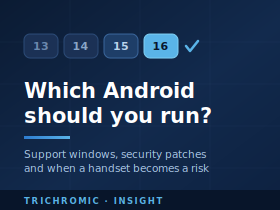
Understanding Android Versions, Security Updates, and When to Upgrade
(Updated: August 15, 2026)
If you’re confused about which Android version your phone should be running, you’re not alone. Unlike Apple’s tightly controlled iPhone lineup, Android’s update system involves Google, your phone’s manufacturer, and sometimes your carrier — and it’s not always obvious whether your device is still secure or when you need to think about upgrading.
This guide explains how Android versioning works, what security patch levels mean, and how to know if your phone is still protected.
Android Versioning: Numbers, Not Years
Android keeps things simple with sequential numbering. Android 16 arrived in 2025, and the current release, Android 17, began its stable rollout on 16 June 2026, first to Pixel devices, with other eligible Android devices following through 2026. So if the year is 2026, the newest Android is 17.
But here’s the catch that Apple doesn’t have: the version number alone doesn’t tell you whether a device is current. Google releases Android, but your phone’s manufacturer — Google, Samsung, Motorola and so on — has to build, test and deliver the update for your specific model. A two-year-old Samsung and a two-year-old Motorola can be on completely different Android versions and both be perfectly healthy.
That’s why on Android you need to look at two numbers: the Android version, and — more importantly — the security patch level.
Major Upgrades vs Security Updates: What’s the Difference?
For most users, there are three types of updates to be aware of: Continue reading →
Published on Saturday 15th August 2026
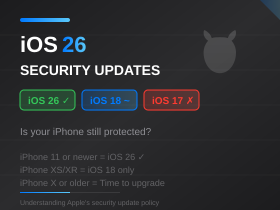
Understanding iOS Versions, Security Updates, and When to Upgrade.
(Updated: 15th August 2026)
If you’re confused about which iOS version your iPhone should be running, you’re not alone. Apple’s approach to software updates has become increasingly complex, and it’s not always obvious whether your device is still secure or when you need to think about upgrading.
This guide explains how Apple’s iOS versioning works, what security updates mean for your device, and how to know if your iPhone is still protected as we approach the next major software cycle.
The New Naming Convention: Why iOS Jumped to 26
If you were expecting iOS 19 after iOS 18, you might have been surprised when Apple released iOS 26 in September 2025. Apple changed their naming convention to align with the calendar year—so iOS 26 is for 2026, similar to how car manufacturers name their models. Continue reading →
Published on Saturday 25th July 2026
Ask an AI assistant to write you a Python script and it will usually run first time. Ask the same tool for a PowerShell script that audits mailbox permissions or disables dormant user accounts, and the odds shift noticeably. The script will look right. The indentation will be immaculate, the comments helpful, the structure sensible. And somewhere in the middle there will be a command that has never existed, or a parameter that was quietly retired three years ago. For anyone keeping a small business network running, the gap between “looks right” and “is right” is worth understanding, because it changes how these tools should be used.
The failure that does not look like a failure
When an AI assistant gets Python wrong, you usually find out immediately: the script throws an error and stops. When it gets PowerShell wrong, the failure is often quieter. A misspelled cmdlet or an invented parameter fails loudly enough — PowerShell rejects both outright. The dangerous cases are the quiet ones. Under PowerShell’s default settings, a filter that refers to a property which does not exist will often match nothing at all rather than raise an error, so a script that should have found forty mailboxes reports a tidy run against none. A command whose behaviour differs between Windows PowerShell 5.1 and PowerShell 7 can do exactly the wrong thing without complaint. And an -ErrorAction SilentlyContinue added to keep the output clean will suppress precisely the failure you needed to see.
Much of the best PowerShell was never published
Continue reading →
Published on Thursday 23rd July 2026
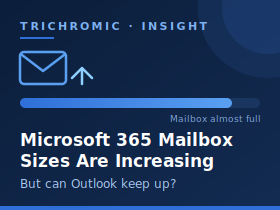
Microsoft is quietly beefing up storage for its Microsoft 365 Business tiers—Basic, Standard, and Premium. The primary mailbox limit is jumping from 50GB to a much healthier 100GB, giving teams plenty of extra room for heavy attachments, years of email history, and everyday clutter.
Keep in mind that this rollout is happening gradually between June and September 2026. Because the update is applied on a per-user basis rather than flipping a switch for the whole company, your team might notice the extra space at different times. Don’t panic if your quota looks different from your desk neighbour’s for a few weeks.
On the surface, this looks like a pure upgrade. Fewer “mailbox full” warnings and less time purging old threads. But there’s a catch Microsoft didn’t mention, and it specifically impacts anyone using the Classic Outlook desktop app.
The hidden 50GB ceiling in Classic Outlook
Even though your cloud mailbox just doubled in size, Classic Outlook relies on a local Offline Storage Table (OST) file to keep things synced and working offline. By default, that local OST file caps out at 50GB.
Once it hits that ceiling, things start to break down. Microsoft does let you manually bump up that local limit via the registry, but they strongly advise against it because massive local files tank performance. When an OST file gets too bloated, you’ll usually see: Continue reading →
Published on Sunday 19th July 2026
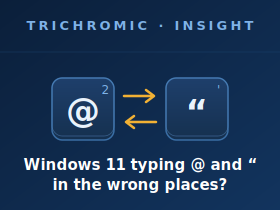
UK keyboard layout may behave like a US keyboard even when Windows settings appear correct
Summary: We recently encountered a Windows 11 PC that began behaving as though it had a US keyboard after a restart. The @ and quotation-mark keys were reversed, yet Windows showed English (United Kingdom) and only the United Kingdom keyboard layout was installed. Here is how to check and correct the problem.
What Are the Symptoms?
The most obvious sign is that the @ and quotation-mark characters appear in the wrong places.
On a standard UK keyboard:
Shift + 2 should produce ".- The key beside the Enter key should produce
@.
When Windows uses a US keyboard layout, these two characters are effectively reversed.
This can be especially confusing because the letters and numbers continue to work normally. Users may initially assume that the keyboard itself is faulty.
Why Does This Matter to Businesses?
A keyboard-layout problem may sound like a minor inconvenience, but it can quickly interfere with normal work. Continue reading →
Published on Monday 1st June 2026

For years, Outlook users had a simple safety net against sending email to the wrong person. If a stale, mistyped or outdated address appeared in the suggestions under To, Cc or Bcc, many users could click the small “X” beside it and stop that suggestion appearing again. But following Microsoft’s 31 March 2026 retirement of “Contact Masking”, and recent changes to how Outlook generates recipient suggestions, that familiar control is no longer behaving consistently across Outlook clients. Microsoft says the AutoComplete list is not affected. Many users say the experience tells a different story.
Contact Masking was one of the features users experienced through that familiar “X”. It allowed a user to hide a specific suggested recipient, so that the address would no longer appear when they composed a new message. Microsoft says it had become a recurring source of customer confusion and support escalations, because contacts could be hidden for one user but remain visible to others, and the behaviour was inconsistent across Outlook, Teams and Microsoft 365 Search. In its retirement notice (MC1234566), Microsoft says no replacement is planned for Contact Masking, and that previously hidden contacts may now reappear in addressing fields.
On paper, that should not affect the separate AutoComplete list, the locally cached suggestions Outlook builds up from addresses you have sent to before. In its own retirement notice, Microsoft is at pains to say that the AutoComplete list for Outlook will not be impacted by this change, and that users can still remove entries from their autocomplete history. Microsoft’s published guidance on the AutoComplete list still tells users they can remove an individual entry by selecting the X beside a name, or by highlighting it and pressing Delete. In theory, the X for Contact Masking is gone, but the X for AutoComplete should remain. Continue reading →
Published on Wednesday 27th May 2026

As Microsoft pushes Copilot deeper into Microsoft 365, owners and managers of small and medium-sized businesses face a confusing licensing landscape, shifting product names and price rises taking effect on 1 July 2026. Here is what has changed, what is on offer now, and the controls every administrator should understand.
For most UK small and medium-sized businesses, Microsoft 365 has quietly become the backbone of daily operations: email in Outlook, files in SharePoint and OneDrive, meetings in Teams, and documents in Word, Excel and PowerPoint. Over the past three years, Microsoft has been layering an artificial intelligence assistant — Copilot — on top of that stack. What started as a single premium add-on has fragmented into a confusing patchwork of free tiers, paid tiers, bundles and admin controls. And the rules keep changing.
With significant pricing changes due on 1 July 2026, a new SME-friendly licence already on the shelves, and free Copilot features being pulled from Office apps for unlicensed users at larger firms, now is the moment for business owners to take stock. Continue reading →
Published on Saturday 9th May 2026
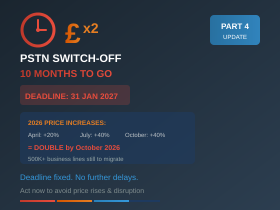
Deadline Fixed, Legacy Prices Rising, and Copper Broadband Must Be Migrated Properly
With the PSTN switch-off now close, this is no longer something businesses can leave on the to-do list for “later”.
The deadline is fixed at 31 January 2027. Openreach has already confirmed 2026 price rises for legacy WLR (Wholesale Line Rental — the traditional phone-line product Openreach sells to communications providers, who then resell it to you as your line rental) services, and the biggest remaining area of confusion is broadband: if you still have a copper DSL service, the right migration path depends on whether FTTP is available at your premises.
If your business still relies on analogue lines, ISDN, or broadband tied to a traditional phone service, now is the time to review every circuit and every connected device.
The Deadline Is 31 January 2027
All users of the Openreach PSTN must be migrated to new services by 31 January 2027.
This is not only about voice calls. It also affects legacy services built around the old WLR/PSTN model, including analogue lines, ISDN and broadband services that still depend on a traditional phone line.
In practice, that means many older services now need to be replaced with digital alternatives such as FTTP or SOGEA.
Openreach Is Increasing Legacy Line Prices in 2026
Openreach has announced a series of WLR price increases during 2026 to push the remaining migrations through: Continue reading →
Published on Wednesday 22nd April 2026
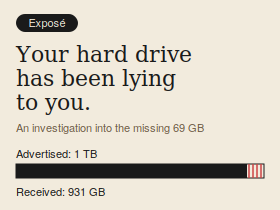
A humorous explainer on bits, bytes, storage, and the strange unit system that still confuses modern computing.
Our technology correspondent descends into the microscopic society living inside your laptop and returns with troubling news.
You may not be aware of this, but at this very moment there is a bustling society of microscopic workers living inside your laptop, your phone, and that suspiciously warm router in the hallway. They have a rigid class system. They have internal squabbles that were settled by committees decades ago and have never been revisited. And they are, almost without exception, much smaller than you’d think.
Allow me to introduce them.
The Bit: A Humble Beginning
At the bottom of the digital food chain lives the bit – the smallest employee in computing, paid in either a 0 or a 1 and nothing in between. Bits have exactly two moods and have shown no interest in developing a third. They have been asked, repeatedly, over the course of seventy-plus years, whether they might like to try being a 2. They have declined every time.
A single bit is, frankly, useless on its own. It can tell you whether the light is on or off, and that’s about it. This is why bits are never seen alone in polite society. They travel in packs.
The Nibble: A Unit Nobody Takes Seriously
Continue reading →
Published on Friday 17th April 2026

We get asked a lot of the same questions by businesses looking to move their IT to a proper managed provider. Here are the ones that come up most often, with straight answers.
Why would you use Trichromic?
If you value IT in your business and want a provider who actually cares about keeping things running smoothly, we’re a good fit. We’re passionate about what we do, genuinely pro-active, and we insist on getting to the root of chronic problems rather than patching the same issue month after month.
Why would you NOT use Trichromic?
If IT is just a cost you want to minimise — or you’d rather only hear from your IT provider when something’s broken — we’re probably not for you. We work best with businesses who see reliable, secure IT as an investment in their own productivity and reputation.
What makes Trichromic different?
Two things. First, our pro-active approach — we’re not content to just fix what’s in front of us, we want to stop issues recurring. Second, we run our own infrastructure and apply the same security standards we recommend to our clients, including the principles behind Cyber Essentials.
How long has Trichromic been in business?
Since 2006. Trichromic LLP is owned by Alex Bailey and Lloyd Reid, who still run the business day to day. Continue reading →




