HMRC has awarded AWS a contract to migrate services from three Fujitsu datacentres running everything from Unix variants to Windows and VMware. The technical challenges are significant—and the procurement process raises its own questions.
On 23 March 2026, HMRC awarded Amazon Web Services a contract worth £472.8 million to migrate services from three Fujitsu-run datacentres to the cloud. The initial term is seven years, with extension options that could take it to ten. The migration is due to be completed by June 2028.
That’s just over two years to exit datacentres running a remarkably diverse mix of systems—a legacy estate that has been accumulating for decades. The way the contract was awarded raises questions about competition in government IT procurement.
What’s Actually Being Migrated
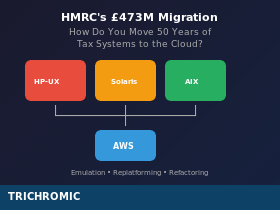
The procurement documents describe a mixed legacy estate spanning about a dozen platforms and operating environments. These include Unix variants like HP-UX, IBM AIX, and Solaris, but also Red Hat Linux, SUSE Linux, Windows, VMware ESXi, Oracle Linux, and NetApp ONTAP storage systems.
This isn’t a pure “mainframe migration” of the kind that involves converting COBOL to Java. It’s a datacentre exit involving a broad mix of technologies, some of which run on standard x86 hardware and some of which don’t.
The Unix systems present the most interesting technical challenge. Legacy HP-UX, Solaris and AIX environments are tied to processor architectures such as PA-RISC or Itanium, SPARC and IBM Power respectively, which complicates direct migration to standard x86 cloud infrastructure. The existing binaries won’t run natively without recompilation or emulation.
The Windows, Linux, and VMware workloads are more straightforward in principle—AWS has mature tools for migrating these—but “straightforward” is relative when you’re dealing with systems built up over decades, where institutional knowledge may be patchy and some business rules may be poorly documented.
How Do You Move Systems That Can’t Be Copied?
For many x86-based Windows and Linux workloads, including some systems hosted on VMware, AWS offers mature migration tooling that can reduce the amount of application change required.
For the non-x86 Unix systems, the options are more limited and more complex.
Hardware emulation. Specialist software from partners like Stromasys can emulate legacy SPARC and PA-RISC hardware on modern x86 servers, including in AWS. The legacy operating system and applications run unchanged because they think they’re running on the original hardware. AWS has published guidance on using Stromasys Charon for HP-UX and Solaris workloads.
The advantage is speed and low risk: you’re not changing the software at all. The disadvantage is that you’re still running the legacy operating systems and code—and the emulated environment doesn’t convert workloads into AWS-native, container, or serverless services. You’ve moved the technical debt to the cloud rather than eliminating it.
Replatforming or modernisation. For AIX specifically, AWS points to replatforming, modernisation, or hybrid approaches working with partners. This might involve rewriting applications for Linux or maintaining AIX systems in partner-hosted environments with connectivity to AWS.
The procurement is explicitly about exiting the Fujitsu datacentres, while also allowing for transformation and application modernisation where needed. But the June 2028 deadline is ambitious, and the contract includes provisions for additional work including “business services transformation” and “application modernisation”—suggesting the scope may evolve as the reality of the work becomes clear.
The Single-Bidder Problem
AWS submitted the only tender that HMRC received and assessed. The contract was awarded through a competitive flexible procedure that allowed up to three tenderers to be shortlisted.
Reporting by The Register suggests that HMRC initially shortlisted AWS, Google, and IBM, but that Google and IBM both dropped out during the process. Sources quoted in that reporting allege that the requirements were effectively written so that only AWS or Microsoft could realistically deliver—and with Microsoft apparently not in the running from the start, that left AWS alone.
When there’s only one bidder, negotiating leverage is limited. One insider quoted by The Register put it bluntly: “AWS was going into a tender negotiation knowing the value of the contract, and there was zero power for government to negotiate.”
Whether the requirements genuinely needed to be written this way, or whether there was scope for a more competitive process, is something only HMRC can answer. But the outcome—a near-half-billion-pound contract with a single bidder—is not the kind of result competitive procurement is generally meant to encourage.
The Bigger Picture on Cloud Competition
This contract sits against a backdrop of broader concerns about competition in UK cloud services. According to the CMA, AWS and Microsoft each hold up to around 30–40% of UK customer spend, putting them at up to roughly 80% combined.
In July 2025, the Competition and Markets Authority published its final decision on the cloud market, concluding that competition is not working as well as it could. The CMA gave an illustrative example that if prices were 5% above competitive levels, the detriment could be around £500 million a year.
On the sovereignty question: the contract was awarded to AWS’s British branch, but AWS is ultimately owned by an American corporation. However, it’s worth noting that HMRC’s procurement required UK-based hosting, with offshore hosting and offshore access to the data explicitly not permitted. The sovereignty concern isn’t that data will leave the UK—it’s about who controls the infrastructure it sits on.
What This Means for Everyone Else
HMRC’s datacentre exit is unusually large and complex, but the underlying challenges will be familiar to many organisations. Legacy systems running on ageing hardware. Applications nobody fully understands. Skills shortages as experts retire or move on. Pressure to modernise competing with the risk of touching systems that currently work.
The good news is that migration tooling has improved significantly. For x86 workloads, cloud migration is well-understood. For exotic Unix systems, emulation provides a viable if imperfect path. AWS and other cloud providers have invested heavily in migration services.
The less good news is that there’s no magic wand. Even with good tools, migration projects require understanding what you have, making difficult decisions about what to do with it, and testing thoroughly. The New York Times, for example, spent about two years on just the code conversion and data migration phase when modernising a single mainframe billing application—and that was one application, not an estate-wide transformation.
For most businesses, the systems in question aren’t decades-old Unix servers—they’re Windows servers approaching end of support, applications on outdated frameworks, or on-premise infrastructure that’s becoming harder to maintain. The scale is different, but the principles are the same: understand what you have, decide what you want, plan carefully, and test everything.
Thinking About Your Own Migration?
At Trichromic, we help businesses plan and execute infrastructure migrations—typically on a rather smaller scale than HMRC’s. Whether you’re moving from on-premise servers to the cloud, planning for Windows Server end of support, or just trying to understand what you’ve got before making decisions, we can help.
Give us a call on 020 3327 0310. We promise not to charge £473 million.




