Deadline Fixed, Legacy Prices Rising, and Copper Broadband Must Be Migrated Properly
With the PSTN switch-off now close, this is no longer something businesses can leave on the to-do list for “later”.
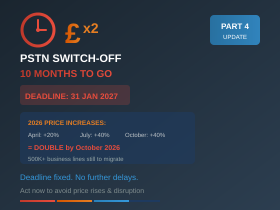
The deadline is fixed at 31 January 2027. Openreach has already confirmed 2026 price rises for legacy WLR (Wholesale Line Rental — the traditional phone-line product Openreach sells to communications providers, who then resell it to you as your line rental) services, and the biggest remaining area of confusion is broadband: if you still have a copper DSL service, the right migration path depends on whether FTTP is available at your premises.
If your business still relies on analogue lines, ISDN, or broadband tied to a traditional phone service, now is the time to review every circuit and every connected device.
The Deadline Is 31 January 2027
All users of the Openreach PSTN must be migrated to new services by 31 January 2027.
This is not only about voice calls. It also affects legacy services built around the old WLR/PSTN model, including analogue lines, ISDN and broadband services that still depend on a traditional phone line.
In practice, that means many older services now need to be replaced with digital alternatives such as FTTP or SOGEA.
Openreach Is Increasing Legacy Line Prices in 2026
Openreach has announced a series of WLR price increases during 2026 to push the remaining migrations through:
- 1 April 2026: 20% increase
- 1 July 2026: further 40% increase on the current price
- 1 October 2026: another 40% increase on the current price, taking rental to double the current price overall
Note that each percentage increase is applied to the original pre-April 2026 baseline rental, not compounded on the running price — which is how the three rises add up to exactly double over the year.
These are wholesale increases, but in practice many providers will pass them on.
That means businesses that stay on legacy lines through 2026 are likely to end up paying significantly more for services that are about to be switched off anyway.
The Broadband Point Businesses Need To Understand
This is the bit that needs to be absolutely clear.
If you still have a copper DSL or broadband service and FTTP is available at your premises, the circuit should be upgraded to FTTP before the January 2027 deadline.
If FTTP is not available, the service still cannot remain on a legacy WLR/PSTN arrangement. It needs to be moved to a single-order product before the deadline.
For FTTC-based services, that will usually mean SOGEA. For older ADSL-style services, the replacement may be another single-order transitional broadband product, depending on what is available at the site and what your provider supports.
So the simple rule is this:
FTTP available? Upgrade to FTTP. No FTTP available? Move to a single-order service before the deadline.
What you should not do is leave a copper broadband service sitting on a legacy phone-line contract and assume it will just carry on unchanged after January 2027.
It’s Not Just About Phones
One of the biggest mistakes businesses make is thinking the PSTN switch-off only affects handsets.
In reality, any device or service that still depends on a traditional phone line may need attention, including:
- fire alarms
- intruder alarms
- lift emergency lines
- door entry systems and intercoms
- fax machines
- older payment or PDQ terminals
- EPOS or monitoring systems
- telecare or health-related devices
- CCTV or alerting systems
- broadband services still tied to a WLR phone line
If anything in your business still uses the phone line to communicate, it needs to be checked before migration.
Why The Deadline Now Looks Firm
One of the major barriers to migration had been telecare and vulnerable-user services. Openreach’s launch of its Prove Telecare migration service has removed much of that barrier, allowing telecare users to move to digital phone lines without losing access to life-saving devices, and large-scale migration is already well underway.
For businesses, the takeaway is simple: this is now in the delivery phase, not the discussion phase.
What Happens If You Do Nothing?
If you do nothing, you should not assume the existing service will simply keep running.
From 1 February 2027, any remaining lines left on legacy services may end up on a very limited emergency voice-only fallback. That is not a proper long-term business solution. It is simply a basic last-resort service designed to help complete the switch-off.
If your line supports anything operationally important, leaving migration until the end creates unnecessary commercial and technical risk.
In Many Cases, Your Network Setup Does Not Need To Change Completely
Another common concern is that moving from legacy copper broadband to FTTP or a single-order product will force a complete redesign of the network.
In many cases, it does not.
If you stay with the same ISP, the migration is often handled as a regrade rather than a move to a completely different service model. That means your provider may be able to keep much of the existing setup broadly the same, including router authentication details, service configuration and, in some cases, your static IP arrangement.
That said, this is still provider-specific and should always be confirmed before the order is placed.
If you are moving to a different ISP, you should normally expect the public IP arrangement to change, because IP addresses are usually allocated from the provider’s own address space.
So if your business depends on firewall rules, VPNs, whitelisting, SIP, remote access, CCTV access or any service tied to your current public IP, ask your provider two direct questions before migration:
- Will our router credentials or WAN settings change?
- Will our existing static IP or public-facing addressing remain the same?
What Happens To Your Existing Line Rental Bill?
If your business currently has a line share arrangement — paying one provider (often BT) for the phone line and a separate provider for the broadband — migration to a single-order service changes how the billing works as well as the technology.
Under the old WLR model, Openreach charged your line provider for the line rental and your broadband provider separately for the broadband. That’s why two bills landed each month. Under a single-order product, Openreach charges your broadband provider once for the lot — the access and the underlying copper or fibre — and you receive a single bill from a single provider.
In practice, this means:
- The separate line rental charge from your existing line provider should cease when the underlying line is ceased as part of the migration.
- The cost of the physical access has not vanished — it is now bundled into your broadband provider’s single price. So when comparing costs, the fair comparison is “old broadband plus line rental” against the new single price, not against broadband alone.
- On FTTP, the copper pair is decommissioned entirely, so there is no copper rental left to charge for at all.
The cease should flow through automatically off the back of the migration order, but billing systems being what they are, check the first bill from your old line provider after the migration date to confirm the line rental has actually dropped off. If it has not, raise it quoting the cease date and the new service go-live date — they should back-credit.
If you are also changing broadband provider as part of the migration, factor in any final bills, minimum-term clauses or pro-rated rentals on the outgoing service when comparing the total cost of staying put against moving.
Can You Keep Your Number?
Often yes, but not always.
In many cases, business numbers can be ported to the new digital service, but it should never be assumed automatically. The exact process depends on the provider and the migration route being used.
If keeping your main number matters, get that confirmed early and get it in writing.
PSTN Switch-Off vs Copper Retirement
It is also worth clearing up one common misunderstanding.
The PSTN switch-off and the wider exchange-exit / copper-retirement programme are related, but they are not exactly the same thing.
For businesses, the practical takeaway is straightforward: even where some copper-based broadband access remains for a period, analogue phone service does not.
So the real issue is not whether copper physically remains in place. The issue is that analogue voice services over that infrastructure are ending.
What Businesses Should Do Now
Start with a proper estate review. Identify every service that depends on a traditional line, not just desk phones.
Then speak to your provider and ask:
- is FTTP available at each site?
- if FTTP is available, when will the circuit be upgraded?
- if FTTP is not available, which single-order product will replace the current service?
- can our numbers be ported?
- will our router settings or static IP arrangement change?
- will our existing line rental bill cease automatically when the line is ceased, or do we need to action that separately?
- do any connected devices need replacing or reconfiguring?
Most importantly, do not leave it until late 2026. The later you move, the more exposed you are to higher legacy charges, rushed migrations, supply bottlenecks and unnecessary disruption.
How Trichromic Can Help
At Trichromic, we’ve been helping customers prepare for the PSTN switch-off for several years.
If you are not sure whether a site should move to FTTP or a single-order service, whether your current broadband is still tied to a legacy phone contract, or whether your existing numbers, credentials and IP setup can be preserved, we can help you assess the estate and plan the migration properly.
Call us on 020 3327 0310.
Last updated: May 2026




