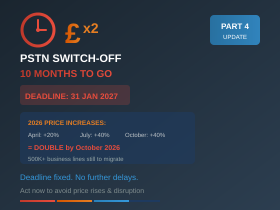
Ten Months to Go: Prices Rising, Deadline Fixed
We’ve written about the PSTN switch-off before, but with just ten months until the 31 January 2027 deadline, the situation has changed significantly. Openreach has made it clear there will be no further delays, and they’re now using price increases to force the remaining businesses off legacy lines.
If your business is still using analogue phone lines, ISDN, or copper-based broadband (ADSL or FTTC with a phone line), this article explains what’s happening and what you need to do.
The Deadline Is Fixed
The Public Switched Telephone Network will be permanently switched off on 31 January 2027. This date has already been pushed back once—from December 2025 to January 2027—to give providers more time to migrate vulnerable customers with telecare devices. Openreach has stated there will be no further extensions.
According to Openreach, all technical barriers to migration have now been resolved. Their “Prove Telecare” service, launched in October 2025, allows the safe migration of telecare and health-alarm users. The focus is now entirely on completing the final phase of migration.
BT has already migrated over 3 million households to their Digital Voice service. But more than half a million business lines remain on legacy copper infrastructure and haven’t made the switch.
Prices Are Doubling This Year
To push the remaining customers off legacy services, Openreach has announced a series of steep price increases for Wholesale Line Rental (WLR) products during 2026:
1 April 2026: Prices rise by 20%
1 July 2026: Prices rise by a further 40%
1 October 2026: Prices rise by another 40%, effectively doubling the rental cost compared to 2025 rates
These wholesale price increases will be passed on to customers by their providers. If you’re still on a legacy service by October, you’ll be paying double what you paid last year for a service that will stop working entirely in January.
James Lilley, Director of All-IP at Openreach, put it bluntly: “The PSTN analogue network is obsolete, becoming harder to maintain and significantly more expensive to run. We are passing those costs on to providers who continue to sell legacy products. If your business is still on this copper service, you will start to pay a premium for a service that will be switched off.”
What Happens If You Do Nothing
If you ignore all the migration notices and do nothing, your analogue service will eventually stop. On 1 February 2027, you’ll wake up to find your FTTC broadband connection is down and your landline has no dial tone.
For customers who haven’t migrated by the deadline, Openreach plans to move them to an “Emergency Voice Access” service—a basic, no-frills digital service that emulates PSTN-like features. But this is a last resort, not a proper solution. If you have critical systems connected to your phone line—alarms, card machines, lift lines, CCTV—they may not work properly or at all.
It’s Not Just Phones
The switch-off affects everything connected to a traditional phone line, not just voice calls. Openreach’s data shows there are still over 12,000 lift lines and around 500 CCTV lines that need to be upgraded. Across the UK, businesses are running:
Fire and burglar alarms connected to monitoring centres via phone lines. Payment terminals (PDQ machines) that dial out to process transactions. Door entry systems and intercoms. Fax machines (yes, some industries still use them). EPOS systems and vending machines. Emergency lift phones required by building regulations.
Each of these needs to be identified, assessed, and either replaced or migrated to a digital alternative. If you leave this until the last minute, you risk service disruption—or worse, compliance failures if your fire alarm can’t communicate with the monitoring station.
The Good News
The replacement technology is mature, reliable, and often cheaper than what you’re paying now. VoIP (Voice over Internet Protocol) has been around for years—the early problems with call quality are long gone. Most businesses that have already made the switch are happy with the result.
You can keep your existing phone numbers. The process of “porting” your number from the old analogue line to a new digital service is straightforward and handled by your provider.
In many cases, it’s already cheaper to be on new digital products than to remain on legacy services—even before the price increases kick in. Once you factor in the 2026 price rises, the financial case for switching early is overwhelming.
Clearing Up a Common Confusion
There’s a lot of confusion about what’s actually being switched off. The copper wires themselves are not being ripped out of the ground. What’s being retired is the analogue phone service—the PSTN—that runs over those wires.
After January 2027, you can still have broadband delivered over copper using products like SOGEA (Single Order Generic Ethernet Access). SOGEA is essentially the same as FTTC broadband, but without the phone line component. The copper pair from the cabinet to your premises stays in place; you just can’t make analogue phone calls over it anymore.
This matters because if you currently have FTTC broadband bundled with a phone line (WLR), you’ll need to migrate to SOGEA to keep your broadband working. Your provider should be contacting you about this. The migration is usually straightforward—often done remotely with no engineer visit—but it typically involves moving to a new contract.
Different providers are handling this differently. Some are proactively migrating customers; others are waiting for you to request the change. If you haven’t heard from your provider about SOGEA migration, contact them now to understand their process and timeline. Don’t assume it will happen automatically.
Of course, if full fibre (FTTP) is available at your premises, that’s the better long-term option. FTTP doesn’t use the copper at all and offers faster, more reliable connectivity. In many areas, the price difference between SOGEA and FTTP is now minimal.
What You Need To Do
Review your estate. Identify every service in your business that relies on a phone line. Don’t just think about phones—check alarms, card machines, lifts, fax machines, and any equipment that “dials out.”
Contact your provider. If they haven’t already been in touch about migration, ask why. Most major providers moved their customers to digital services long ago. If yours hasn’t contacted you, you may want to consider whether they’re the right provider for your business.
Don’t wait. The longer you leave it, the more expensive your current service becomes, and the greater the risk of being caught in a last-minute rush. Engineers and equipment will be in high demand as the deadline approaches.
How Trichromic Can Help
At Trichromic, we’ve been helping our customers prepare for this transition for several years.
If you’re unsure whether your business is affected or what you need to do, give us a call on 020 3327 0310.
Last updated: March 2026